Little Tunny Details
Photos
 aqualung posted in CT
 Baits and Tackle for Little Tunny
Saltwater Fly Check Prices
- Epoxy Bay Anchovie Pattern Size 2
Little Tunny Description
Range & Habitat:
This fish is distributed Gulfwide in blue and green water at all depths. It comes closer to shore than any other tuna species.
Identification & Biology:
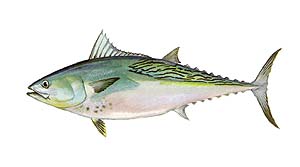
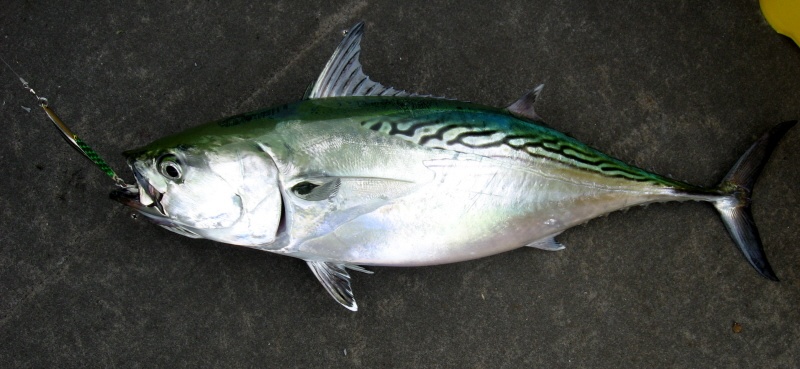
This fish has a "tuna-shaped", but streamlined body. The back is steel blue to dark blue in color and has a patch of wavy lines on the rear part of the back. The belly is very white and has several dark spots on each side between the pectoral and pelvic fins. No other species with a back-patch of wavy or mottled lines has these spots, although the spots may be hard to see on some fish. The closest look-alike to the little tunny is the less common Atlantic bonito. Besides lacking the belly spots, the patch of wavy lines on the back of the Atlantic bonito extends further forward, to a point equal to the front of the dorsal fin. In the little tunny, the patch of lines begins at a point about halfway back from the beginning of the fin.
Little tunny are a strongly schooling species that can form schools nearly a mile long. When a large school is actively feeding, they are very noisy, keeping the water splashing and foaming. They feed most heavily on fishes such as herrings, sardines and scads, but they will also readily take squid and crustaceans. They are fast-growing, but short-lived fish. At one year of age and 14 inches, they are mature enough to spawn, which takes place offshore in waters over 100 feet deep. Little tunny seldom live over 5 years.
Size:
Little tunny average 10-12 pounds, but are not rare over
20 pounds.
Food Value:
Good; better than its reputation, but because of the very red flesh, they are seldom eaten. It is important to bleed this fish quickly and get it on ice. Best if eaten fresh. Do not freeze.